Master Kosen Thibaut, a Life for Zazen
A voice. A chest
. A laugh. A breath. A near-filial relationship with Taisen Deshimaru. A passionate practice of zazen from the moment he met his master until his last day, despite illness. An unwavering loyalty—not so much to Buddhism as to the posture of zazen itself. An inexhaustible energy to transmit what he called a heritage of humanity
, across two continents. A living teaching, born of an intimate understanding of Zen, at once adapted to the present, oriented toward the future, and faithful to the lineage of masters since the Buddha.
These are some of the most striking characteristics of master Kosen Thibaut.
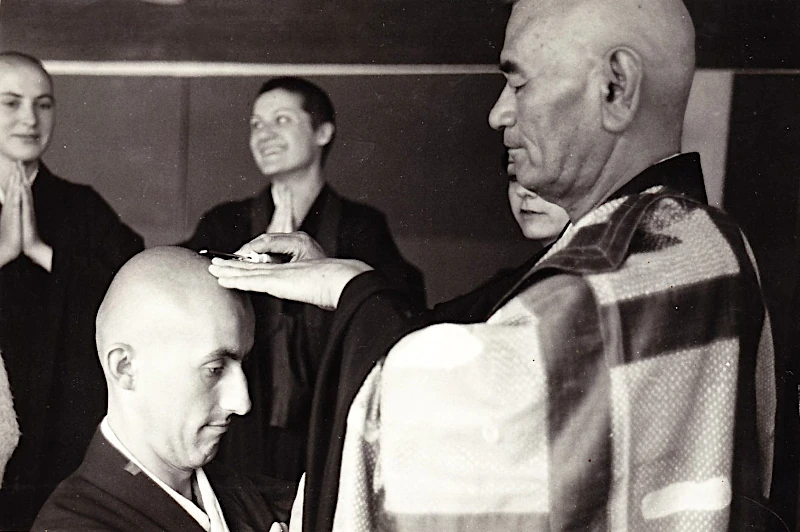
Ordination of Stéphane Kosen Thibaut by master Deshimaru.
Around the age of twenty, Stéphane Thibaut had never truly heard of Zen or Buddhism. His uncle had given him a book on Zen, but philosophy and bookish culture held no interest for him. In search of a spiritual path, he vaguely dreamed of going to India to become a sadhu. As he wandered the streets, a taxi stopped, and a long-lost friend called out to him. She was on her way to a zazen session, and Stéphane accompanied her. The moment he sat in the zazen posture, he understood that this was what he wanted to practice. He had found his path and his master.
He practiced with master Taisen Deshimaru for fifteen years and served as his secretary. Dedicating himself to zazen, he lived at the dojo. He received the bodhisattva ordination from his master, then the Zen monk ordination—twice. The first time, Taisen Deshimaru told him:
Stéphane, you must become a monk.
It was the 1970s, and master Deshimaru had compared Zen monks to hippies, but clean
. Stéphane Thibaut accepted, though he didn’t fully grasp what the ordination meant. Some time later, while living full-time at the Zen dojo, he asked his master for the monk ordination again. Amused, his master agreed.
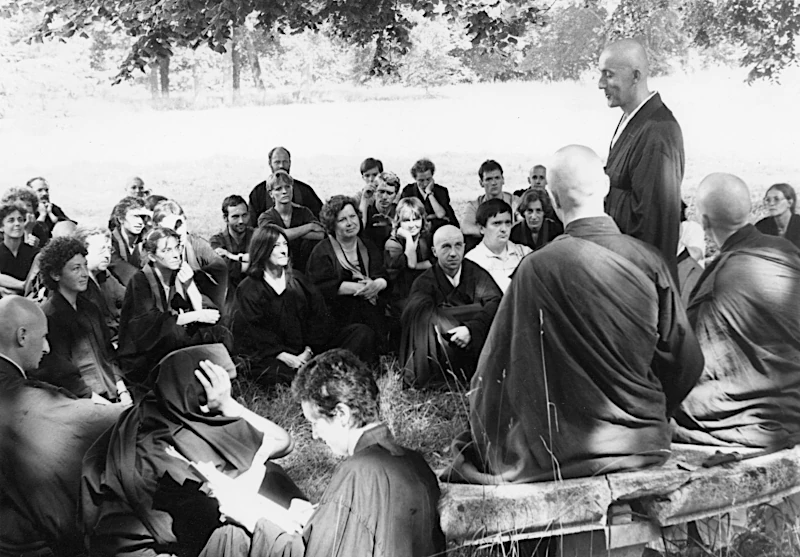
Josy Thibaut (center), founder of Zen Paris, during a session of the 1982 summer camp led by master Kosen (standing).
The death of master Deshimaru in 1982 took everyone by surprise. He had not had time to formally transmit the dharma to any of his disciples. The highest authority of soto Zen in Japan, Niwa Rempo Zenji, ensured the continuity of master Deshimaru’s mission and traveled to France to confer the shiho, the transmission, upon Stéphane Kosen, Étienne Zeisler, and Roland Reich.
When Sensei died, there were Étienne, Roland, and me, and of course, on a phenomenal level, we argued, there was competition, things happened, but the work Roland did is also transmission. It’s significant work, just as important as the work I do. The work Étienne did is also very important, and each of us contributed to something that may unfold in fifty, a hundred, two hundred years.
He began studying under a great master of Chinese medicine, who taught him that zazen was known and practiced in China as calm qi gong
. This master told him:
When you come out of qi gong, when you come out of zazen, you must cut off from it, you must become ordinary again, you must forget.
He thus better understood master Deshimaru’s attitude and the importance of not trying to prolong the zazen state of mind after the session. He would regularly integrate these health-focused insights to guide practitioners on improving their posture and finding the right mental attitude.
But master Kosen wished to remain faithful to the direct lineage teaching of Zen, from master to disciple, which was hardly compatible with institutional structures. In 1992, he left the AZI, the association founded in 1970 by his master, to teach in Rennes, Amsterdam, and Montpellier. In 2002, he founded the ABZD, a lightweight structure that allowed for organizing sesshins within a clear legal framework.
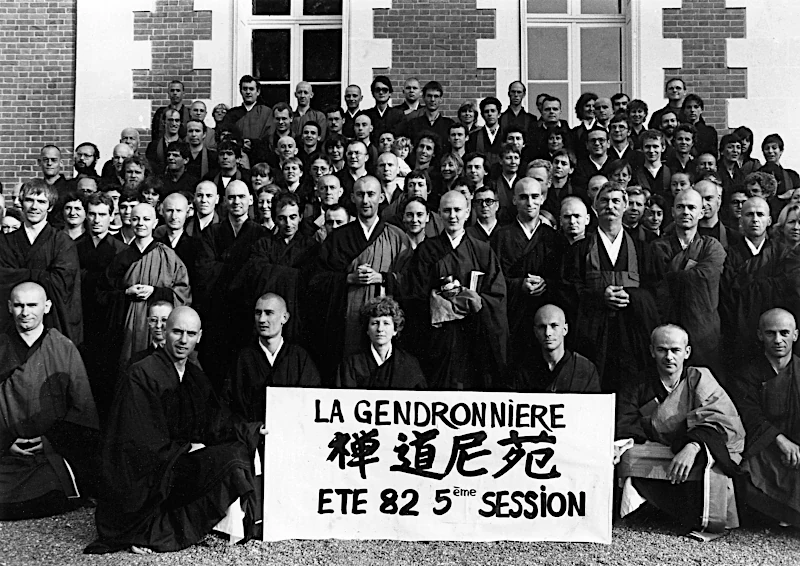
Master Kosen leading the 5th session of the 1982 summer camp at the Zen temple of La Gendronnière.
Master Kosen (1950-2025) was a major figure in the establishment of soto Zen in France, Europe, and South America.
He led numerous sesshins and founded highly active dojos in Europe and South America. He also established several Zen temples in Cuba, Argentina, and France, in the Haut-Languedoc, including the Zen temple Yujo Nyusanji.
Stéphane, you can do whatever you want in your life: drink, make love… That’s none of my business, it doesn’t interest me. Do what you want, but be here at the dojo in the morning! - Taisen Deshimaru
While his oral teachings, his kusens, were marked by great originality, they remained perfectly faithful to the tradition of Zen Buddhism. For several years, he commented on the notion of continuous practice, gyoji, and the Hannya Shingyo, the Heart Sutra. In the early 2000s, he discovered the Prajna Paramita, the Perfection of Wisdom, from which the Heart Sutra is extracted, in the monumental French translation by the Catholic priest Étienne Lamotte. He devoted himself to studying it in depth to draw kusens from it, and later, a book.
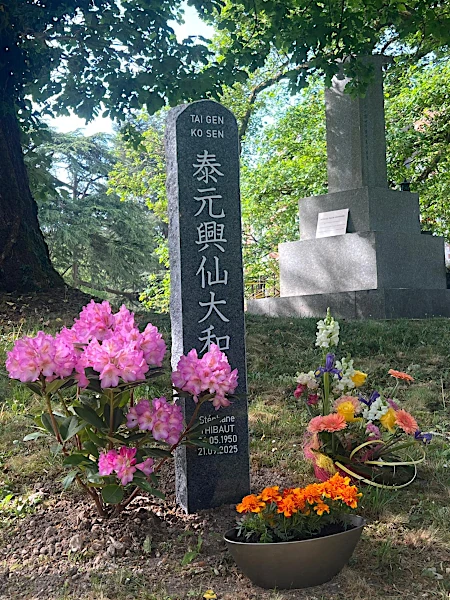
Stele dedicated to master Kosen, at the foot of the stele dedicated to master Deshimaru, at the Zen temple of La Gendronnière.
Master Kosen helped train several generations of practitioners and teachers. His teaching, direct and undogmatic—even iconoclastic—in the great Zen tradition, emphasized integrating Zen into daily life.
Master Kosen Thibaut devoted over fifty years of his life to zazen. He left a lasting legacy through his commitment, his oral teachings, his writings, and the sangha he helped bring to life.
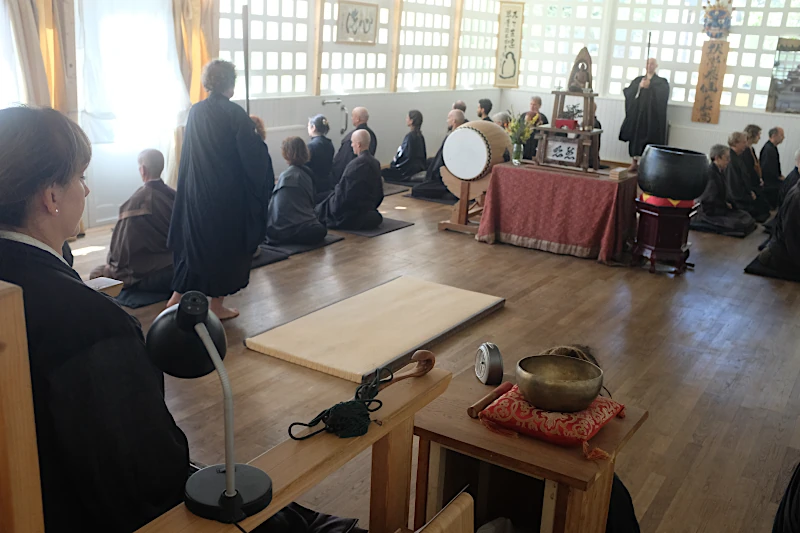
Master Kosen’s successors continue his mission at the Zen temple Yujo Nyusanji, which he founded in the Haut-Languedoc.